An SEO site audit that hands you a fix list, not a data dump
TaskGlaze crawls every page you own, scores each one, and returns the issues that actually cost you rankings — ordered by how many pages they hit, each with the fix.
- technical and on-page issue types checked
- 200+
- sitemaps plus a real link crawl
- Whole site
- daily, weekly or monthly, with a change log
- Scheduled
Where Site Audit fits
Runs alongside the loop, on the site you're building links to.
Most technical SEO audits fail the same way: four thousand rows, and you're left to work out which twelve matter. The broken canonical on your money page sits at row 900 next to eight hundred image-alt notices.
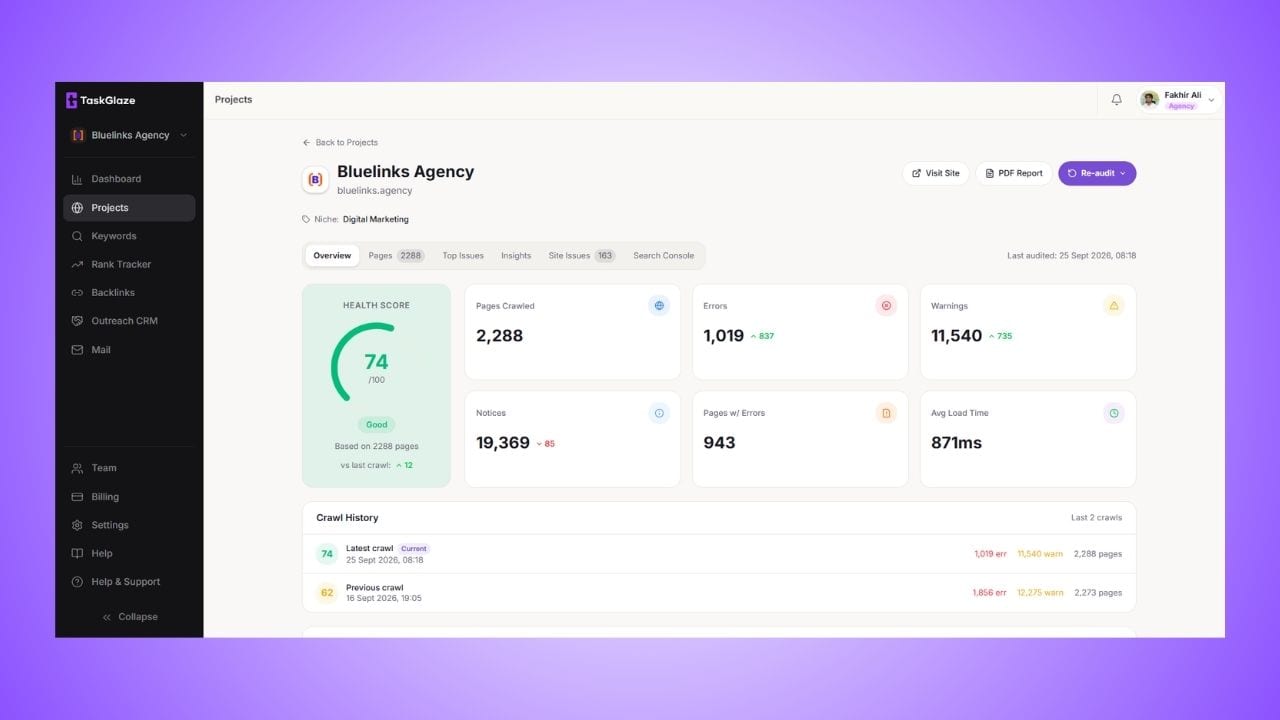
A TaskGlaze audit starts with a real crawl — robots.txt, your sitemaps and your internal links together, so live pages missing from the sitemap still get found, and JavaScript-rendered pages are re-read in a headless browser instead of scored as empty. Every page is checked against more than 200 issue types, scored, and rolled up into one list: errors first, and within that the problems hitting the most pages.
Site Audit, step by step
Point it at a domain
TaskGlaze resolves the real host first — www or not, http or https — then builds one URL set from your sitemaps and a genuine link crawl, ordered homepage first, sitemap URLs next, shallow pages before deep ones.
Every page is fetched and checked
robots.txt rules are honoured, nofollow is respected when harvesting links, and a page with suspiciously thin text is re-rendered in headless Chromium before it's judged. Each page gets its own score.
Issues roll up into a priority list
Page findings aggregate into site-level issues, each with the pages affected, an example URL and the fix. Problems that only exist between pages — duplicate titles, redirect chains, orphan pages, broken links, keyword cannibalisation — get their own section.
Schedule it and watch for regressions
Re-audit daily, weekly or monthly and each crawl is compared with the last: new issues, fixed issues, pages that appeared or vanished, links that broke. A health-score move of three points or more is recorded as its own event.
What's included in Site Audit
A real crawl, not a one-page check
Sitemaps and a live link crawl together, so the audit covers the site as it actually exists. Pages per audit depend on your plan.
200+ issue types in one pass
Indexability and canonicals, titles and headings, link health, URLs, duplicate and thin content, schema, images, social tags, hreflang, mobile, accessibility, security headers and llms.txt.
Every issue comes with the fix
Each finding has a severity, the pages it affects, an example URL and a written how-to-fix.
Site-wide issues get their own view
Duplicate titles and descriptions, redirect chains, orphan pages, broken links and cannibalisation are reported as problems between pages, with the URLs listed.
Scheduled re-runs with a change log
Each crawl stores what changed since the last one, so you can show progress instead of asserting it.
PDF export
A server-generated PDF with the health score, score distribution, prioritised issues and worst pages. From Starter up, with your own branding on Pro and Agency.
What it doesn't do
Worth knowing before you sign up.
- Each audit covers up to your plan's page cap; on a very large site the most important pages are crawled first.
- PDF export starts on Starter. On the trial the full results are in the app only.
- The no-signup free SEO audit isn't built yet. The robots.txt tester and sitemap checker are the free tools live today.
Site Audit: common questions
Straight answers. If yours isn't here, ask us and the founder will reply.
Up to your plan's per-audit page cap, listed on the pricing page. The order is deliberate: homepage first, then sitemap URLs, then shallower pages before deeper ones, so if a very large site hits the cap the pages that matter most are already audited.
A single-page checker can't see problems that only exist between pages — duplicate titles, redirect chains, orphan pages, internal links that 404, two pages cannibalising one keyword. Each of those needs the whole site crawled at once.
Yes — daily, weekly or monthly per project, or manual only. Scheduled audits run the same pipeline as manual ones, and each is compared with the previous crawl so new and fixed issues are both recorded.
Yes. robots.txt is fetched before the crawl starts and its rules are applied throughout, using Google-style rule matching. Blocked pages are reported as blocked rather than crawled anyway.
Two free, no-signup tools are live now — a robots.txt tester and a sitemap checker — and a free one-page SEO audit is being built. The full multi-page crawl with scoring, history and scheduled re-runs is in every plan, including the 14-day free trial.
Works with
- Keyword ResearchReal search volume, CPC, competition and difficulty — plus an intent label on every keyword, so you can cut straight to the searches that are ready to buy.
- Rank TrackerName the place, pick desktop or mobile, and TaskGlaze re-checks your Google position on a schedule — keeping every check, so you read a trend instead of one number.
- Backlink AnalysisFilter any domain's backlinks by authority, spam score and dofollow before you fetch, read them by referring domain, and see which sites link to your competitors but not to you.
Choosing between tools? Compare TaskGlaze with Pitchbox, Respona and BuzzStream or see every feature.